
Executive Summary
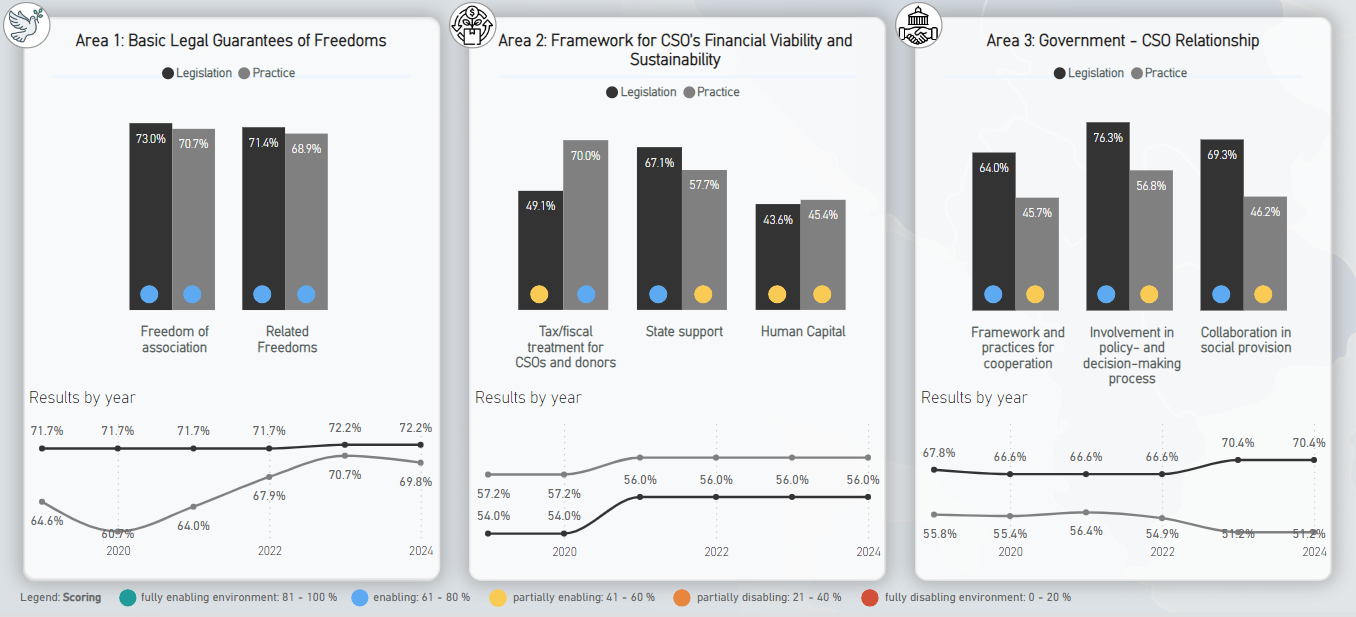
In 2024, the enabling environment for civil society in Montenegro remained formally unchanged but continued to suffer from structural weaknesses, ineffective implementation, and lack of political prioritization. Although the legal framework for freedom of association, assembly, and expression is in place, practical conditions for CSO operation and sustainability remain underdeveloped, and political instability continued to affect cooperation between the state and civil society.
Read more
Freedom of association remains legally protected, and CSOs are able to register and operate without major obstacles. However, the environment remains fragmented and underregulated in certain areas, including the absence of a functional and publicly accessible register of CSOs. This limits transparency and sector coordination. There was no evidence of state interference in CSO registration or operations in 2024. Fundamental freedoms of assembly and expression remained mostly respected in law and in practice. There were no major restrictions on peaceful protests, although local authorities reportedly imposed occasional logistical burdens.
CSOs and journalists, particularly those engaged in investigative reporting or anti-corruption work, continued to face pressure, including smear campaigns and legal threats, often without effective institutional protection. No legal or policy initiatives were taken in 2024 to address SLAPPs or to strengthen safeguards for watchdog actors. Concerningly, political narratives promoting the introduction of a “foreign agent” law gained traction within parts of the parliamentary majority, aiming to stigmatize foreign-funded NGOs. Although the proposal did not advance into legislative procedure and lacked broader political support, it contributed to a hostile atmosphere for independent civil society.
State–CSO cooperation remained largely ad hoc and dependent on political will. The Council for Cooperation Between the Government and NGOs held just one meeting in 2024 and did not function as a consistent platform for dialogue. A positive step toward strengthening the sector was the launch of Montenegro’s first state-funded Resource Center for NGO development, initiated by the newly established Ministry for Regional Investment Development and Cooperation with NGOs. This marks his marks the implementation of a key measure under the Strategy for Cooperation Between State Authorities and Non-Governmental Organizations 2022–2026, and represents the first such program in the Western Balkans, providing dedicated funds for civil society development through 2025 and 2026.
Participation in policymaking remained fragmented and inconsistent. While public consultations were formally conducted for various legislative proposals, CSOs reported that these processes were largely procedural, with limited feedback uptake and little influence on final outcomes. In a welcome development, the Agency for Prevention of Corruption issued an interpretative opinion clarifying that NGO representatives in government working bodies should not be considered public officials. This resolves a long-standing concern that had discouraged CSO involvement in policymaking due to onerous administrative requirements.
The financial sustainability of CSOs continued to be undermined by opaque and fragmented public funding mechanisms. At both central and local levels, funding allocation was marked by lack of transparency, delays, and insufficient oversight. There was no progress in 2024 in improving the quality or predictability of public support, nor in introducing mechanisms for institutional or multi-year funding. Access to state-owned property for CSO use remained unregulated in practice.
Despite these persistent challenges, civil society in Montenegro remained active in key policy areas, including democratic reform, media freedom, and anti-corruption. CSOs continued to participate in regional and EU-level processes, including through the EU–Montenegro Civil Society Joint Consultative Committee, providing independent assessments of the country’s reform efforts. Overall, while the legal basis for civil society remains intact, the operating environment in Montenegro in 2024 was characterized by stagnation, institutional inaction, and unmet commitments to reform. Without proactive measures to ensure transparent funding, meaningful participation, and protection of fundamental freedoms, civil society risks continued marginalization in the country’s democratic development.
Key Positive Developments for 2024
-
The newly established Ministry for Regional Investment Development and Cooperation with NGOs launched a call for proposals to establish a Resource Center consortium. This marks the implementation of a key measure under the Strategy for Cooperation Between State Authorities and Non-Governmental Organizations 2022–2026, and represents the first state-funded Resource Center for NGO Development in both Montenegro and the region. By securing funding for the consortium through 2025 and 2026, the Government of Montenegro has taken a tangible step toward supporting the long-term development and sustainability of civil society.
-
The Agency for the Prevention of Corruption issued an important interpretation of the Law on the Prevention of Corruption, confirming that representatives of NGOs serving on government working bodies are not to be considered public officials. This clarification on NGO participation in government working bodies removes significant legal ambiguity that had previously discouraged NGO participation, as being classified as a public official would have subjected individuals to burdensome reporting requirements and created barriers to further civic engagement and funding eligibility.
Key Negative Developments for 2024
- Montenegro saw a rise in narratives calling for a “foreign agent” law, aimed at increasing control and oversight of NGOs, particularly those receiving foreign funding. These proposals, initiated by a right-wing party within the parliamentary majority, falsely portrayed civil society as “unregulated,” despite facts confirming otherwise. While this rhetoric created additional pressure on the sector, it is notable that no other parliamentary party supported the initiative, and the proposal was not formally submitted into legislative procedure. Nonetheless, the use of such narratives reflects a worrying trend of politicizing civil society and attempting to delegitimize its role in democratic governance.


