
Executive Summary
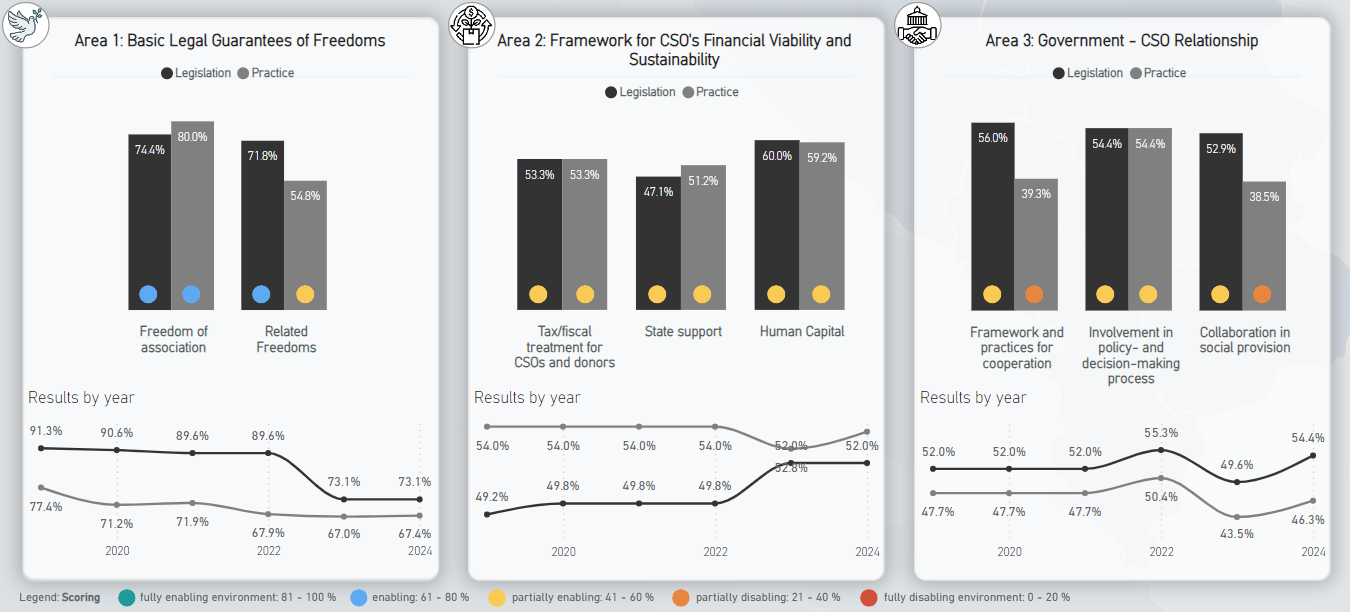
In 2024, the enabling environment for civil society in Bosnia and Herzegovina continued to reflect significant fragmentation, political polarization, and institutional stagnation. While the legal framework guaranteeing fundamental freedoms remains formally aligned with international standards, practical implementation has deteriorated, particularly in Republika Srpska (RS), where restrictive legislation and open hostility towards civil society actors have created a climate of fear and uncertainty. Amid shrinking space in RS, the Federation of BiH (FBiH) and the state level remained relatively stable, with some positive steps toward improving transparency and dialogue, albeit inconsistently applied. Without strong domestic and international action to reverse repressive trends and ensure protections for civil society actors, the country risks deepening democratic backsliding and weakening one of its most vital drivers of accountability and reform.
Read more
The most alarming development of 2024 was the adoption of the Law on the Special Register and Publicity of the Work of Non-Profit Organizations in RS. Widely referred to as the “foreign agents law,” it mandates all NPOs receiving foreign funding and engaging in “political activities” to register in a special list. The law introduces vague and expansive definitions of political activity and foreign support, empowering authorities to suspend or prohibit operations. Despite widespread criticism from domestic and international actors—including the EU, UN, and OSCE—the law entered into force in June 2024. It marks the most severe regression in civic space since the Dayton Agreement and has already had a chilling effect on civil society in RS, with some organizations pausing operations or self-censoring.
Alongside this, ongoing smear campaigns and hostile rhetoric against CSOs and media outlets intensified in RS. CSOs working on governance, human rights, and anti-corruption have been publicly labeled as “traitors” or “foreign mercenaries” by RS government officials and pro-government media. This delegitimization campaign significantly undermines public trust and further polarizes civic discourse.
Freedom of peaceful assembly is largely respected in practice across the country, and there were no major incidents of dispersals or bans in 2024. However, protestors in RS continue to face subtle forms of pressure, including identification checks, surveillance, and public stigmatization, particularly when protests are linked to opposition to government policies or human rights issues. Freedom of expression remains constitutionally protected, but media freedoms in RS deteriorated sharply, particularly following the re-criminalization of defamation in 2023. In 2024, journalists and CSO representatives critical of the government faced legal threats, surveillance, and smear campaigns. The continued use of SLAPPs and administrative harassment is a growing concern, with no legal safeguards in place to protect public watchdogs from abuse of legal systems.
At the same time, the Federation of BiH and state-level institutions showed modest but noteworthy improvements. A key positive development in 2024 was the increased use of public consultations and the publication of legal drafts online, particularly through the e-consultation platform managed by the Ministry of Justice. However, the quality of consultation processes remains inconsistent across institutions and levels of governance. While some ministries incorporated CSO feedback into final drafts, many consultations remain formalistic, lacking meaningful dialogue or feedback mechanisms.
In terms of financial viability, CSOs in BiH face mounting challenges. There is no functional state-level system of support, and most funding is project-based, with limited institutional support. In RS, the foreign agents law poses a direct threat to foreign-funded organizations, while access to public funding is marked by a lack of transparency, political bias, and procedural complexity. In the Federation, the situation is somewhat better, but access to funding remains centralized and unevenly distributed. Tax benefits for CSOs are limited, and no new measures were introduced in 2024 to improve fiscal sustainability.
Despite these challenges, civil society in BiH continues to demonstrate resilience and mobilization, particularly in response to repressive legislation. The adoption of the foreign agents law sparked joint advocacy campaigns, coordinated legal responses, and engagement with international institutions. These efforts underscore the sector’s ability to organize and advocate under pressure, but also highlight the urgent need for systemic protection mechanisms and political accountability. The divergence in conditions between RS and the rest of the country is increasingly pronounced, with RS advancing toward a closed civic space environment, while FBiH and the state level maintain a more open—albeit underdeveloped—framework. This dual reality complicates efforts to develop a coherent national strategy for civil society development or EU-aligned reform.
Key Positive Developments for 2024
- In response to the “foreign agents law” in Republika Srpska, CSOs across BiH coordinated advocacy efforts, submitted legal challenges, and engaged international actors, demonstrating the sector’s resilience and capacity to defend civic freedoms under pressure.
- The BiH Parliamentary Assembly Committee on the EU Integration engaged with CSOs on multiple occasions throughout 2024, showing openness to civil society input on EU-related reforms, in contrast to other institutions where cooperation remains superficial.
Key Negative Developments for 2024
Introduction of a draft “foreign agents law” in Republika Srpska:
A draft Law on the Special Registry and Publicity of Non-Profit Organizations, known as ‘foreign agents’ law, was published on the Ministry of Justice’s website on April 3, 2024, imposing strict reporting and compliance rules on CSOs funded from foreign funding and deemed politically active, going beyond international standards. withdrawn from parliamentary procedure in May 2024 following civil society and international backlash.Escalation of smear campaigns and threats against CSOs and media in RS:
Government officials and pro-government media in RS continued to label watchdog CSOs and independent media as “foreign mercenaries” or “enemies of the state,” exacerbating public mistrust and increasing risks for activists and journalists.Deterioration of media freedoms due to criminalization of defamation:
The ongoing implementation of re-criminalized defamation laws in RS created a chilling effect on public discourse. Journalists and activists critical of the government faced increased surveillance, legal intimidation, and administrative harassment, without access to protective mechanisms.


