
Executive Summary
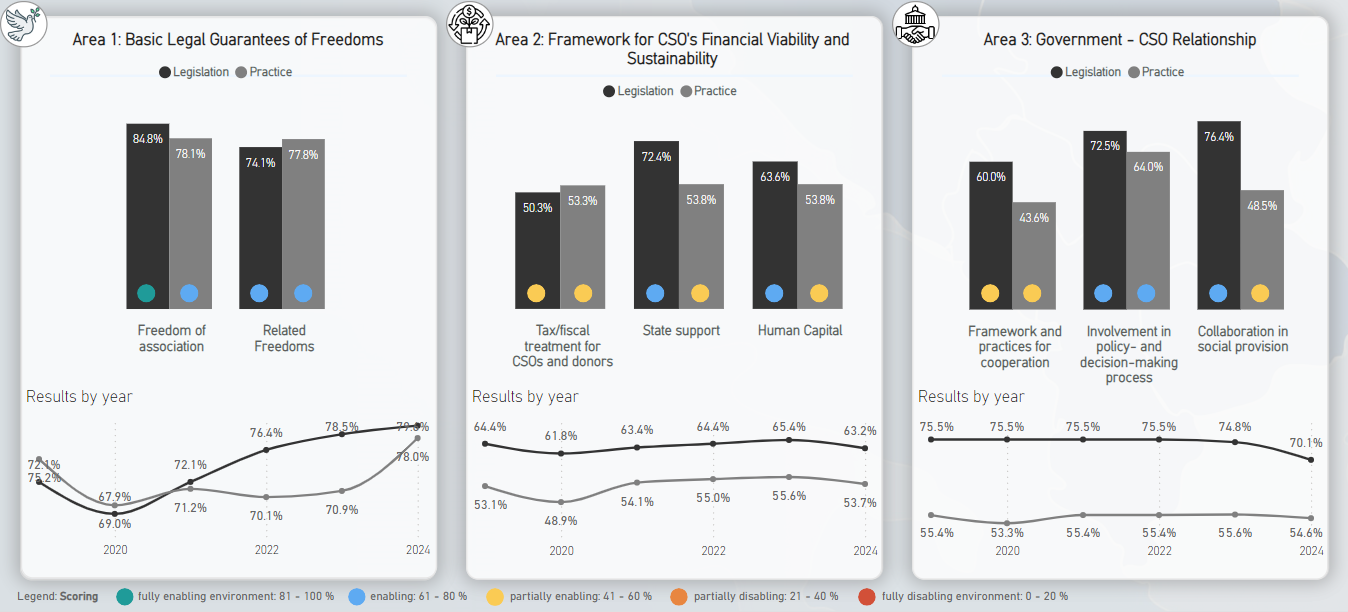
Civil society in Albania continues to operate in a generally enabling legal environment, but faces persistent challenges in practice that constrain its development, autonomy, and effectiveness. The institutional commitment to an enabling environment remains limited, with key gaps in implementation, financial sustainability, and inclusive cooperation with public authorities.
Read more
Despite legal provisions allowing for straightforward CSO registration and guaranteeing freedom of association, the lack of a functioning electronic registry—legally required to be operational by the end of 2023—continues to undermine transparency, efficiency, and access to timely data. Registration remains centralized and burdensome, especially for organizations outside Tirana. In parallel, a draft law introduced in 2024 includes problematic provisions, such as duplicative administrative offenses, that risk creating legal uncertainty and increasing burdens on CSOs.
Legal guarantees for related freedoms—peaceful assembly, expression, and access to information—remain formally in place and largely respected in practice. Assemblies took place without restriction, and there were no reported violations. However, freedom of expression is increasingly at risk due to the rise of SLAPPs, with 73 cases reported, and the lack of legal safeguards. Civil society actors also raised concerns over new initiatives, such as the parliamentary committee on disinformation and a government-imposed TikTok ban, warning of potential misuse to restrict online activism and public debate.
While state interference in CSO operations remains limited, the financial framework continues to impose significant obstacles. Chief among these is the ineffective implementation of VAT exemption procedures for donor-funded projects. Although formalized in 2023, the procedures remain unworkable in practice due to ambiguous requirements and excessive administrative burdens. This undermines Albania’s commitments under the EU IPA III framework and significantly affects the operational viability of the sector. Public funding mechanisms remain modest and fragmented. Central institutions such as the Agency for the Support of Civil Society (ASCS) continue to distribute small-scale project funding, but transparency regressed in 2024, with limited publication of detailed grant data. Municipal-level support remains inconsistent and largely donor-driven. Institutional support and co-financing mechanisms are underdeveloped, and free legal aid funding to NPOs was suspended due to procedural delays.
State–CSO cooperation continues to be formal but largely ineffective. The National Council for Civil Society (NCCS) convened regularly in 2024 but remains a consultative body with limited influence on decision-making. The government has not yet finalized the new Roadmap for Civil Society Development (2024–2027), and the previous cycle (2019–2023) saw only minimal implementation. Broader strategic frameworks for democratic institutions and EU integration reference civil society but lack clear mechanisms for structured engagement. Opportunities for meaningful participation in policymaking remain limited and uneven. Although the number of public consultations increased, CSOs report limited ability to influence outcomes. Regional disparities persist, with CSOs outside the capital facing significant barriers to participation. Mechanisms such as the Partnership Platform for European Integration have yet to deliver consistent and inclusive engagement.
Key Positive Developments for 2024
- The Albanian Financial Intelligence Agency (AIF), in collaboration with civil society, issued a dedicated guideline to help NPOs better understand and address terrorism financing risks. This initiative demonstrates progress in aligning AML/CFT obligations with the risk-based approach and was welcomed by CSOs as a constructive response to their long-standing concerns about disproportionate treatment under the current AML framework.
Key Negative Developments for 2024
- The absence of a fully functional and accessible electronic registry of NPOs significantly undermines the transparency, efficiency, and accountability of NPOs in Albania. Currently, NPOs face administrative burdens and delays due to paper-based registration and re-registration processes, that hinder timely updates, public access to information, and data verification.
- The failure to regulate and implement VAT exemption on foreign funding greatly challenges the financial sustainability of the sector. Despite the approval of VAT exemption procedures in 2023, ambiguous provisions rendered them impractical, obstructing NPO operations.
- Lack of government’s commitment toward the implementation of the Road Map for the Government Policy towards a More Enabling Environment for Civil Society Development, reflected in the low level of the 2019-2023 Road Map and lack of an official assessment report, as well as lack of public information and engagement, and delays in the preparation of the 2024-2027 Road Map.


