
Executive Summary
2023 has been a year of significant shifts for BiH, reflecting both progress and persistent challenges in its socio-political landscape. The general elections held in October 2022 resulted in a continued political stalemate, with key positions in the government, particularly at the state level, being filled only after prolonged negotiations that extended well into 2023. This delay in government formation exacerbated existing tensions and blocked the implementation of crucial reforms, particularly those related to the rule of law and electoral integrity. The impact on civil society has been significant, as organizations operate in a highly polarized and unpredictable environment.
Read more
Bosnia and Herzegovina is politically decentralized with one national, two entities, one district, ten cantonal, and 147 local governments, each with significant autonomy. This structure blocks national policy consensus, enabling ruling ethno-nationalist parties to stay in power through patronage, clientelism, and corruption. The fragmented system reduces transparency and limits citizen access, with public administration divided across 80 institutions, making coordination almost impossible. As a result, socio-economic rights have significantly deteriorated. Mismanagement and inefficiencies worsen these problems, trapping the state in a cycle of dysfunction.
BiH is struggling with both inflationary pressures and limited growth. The cost-of-living crisis, driven by global inflationary trends, hit vulnerable populations the hardest, increasing demand for the services provided by civil society organizations (CSOs). The lack of a coherent economic strategy from the government further strained the capacity of CSOs to meet these growing needs.
Bosnia and Herzegovina’s EU integration journey in 2023 was marked by both milestones and regression. The European Union granted the country candidate status in December 2022, a significant step forward in its long-term goal of EU membership. However, progress on meeting the 14 key priorities set by the European Commission remained slow, with reforms in areas such as the judiciary, public administration, and the fight against corruption lagging. Civil society has been at the forefront of advocating for these reforms, but their efforts have been hampered by limited political will and bureaucratic inertia. The European Commission’s annual report on Bosnia and Herzegovina, published in October 2023, highlighted these challenges, noting that while some progress had been made, much work remains to align with EU standards. Civil society organizations in Bosnia and Herzegovina have united around the “Civil Society Declaration: We Want to Move Forward to the EU!”. In a joint request addressed to local authorities and the international community, 118 organizations expressed their determination and readiness to join the European Union. They emphasize that opening negotiations is crucial for the country’s future and its European path.
In this complex and evolving context, the role of civil society in Bosnia and Herzegovina remains indispensable. This report provides an in-depth analysis of the state of civil society in 2023, highlighting the challenges faced, the progress made, and the critical areas where further efforts are needed. As Bosnia and Herzegovina continues toward greater stability, prosperity, and integration with the European Union, the contributions of civil society will be crucial in shaping the country’s future.
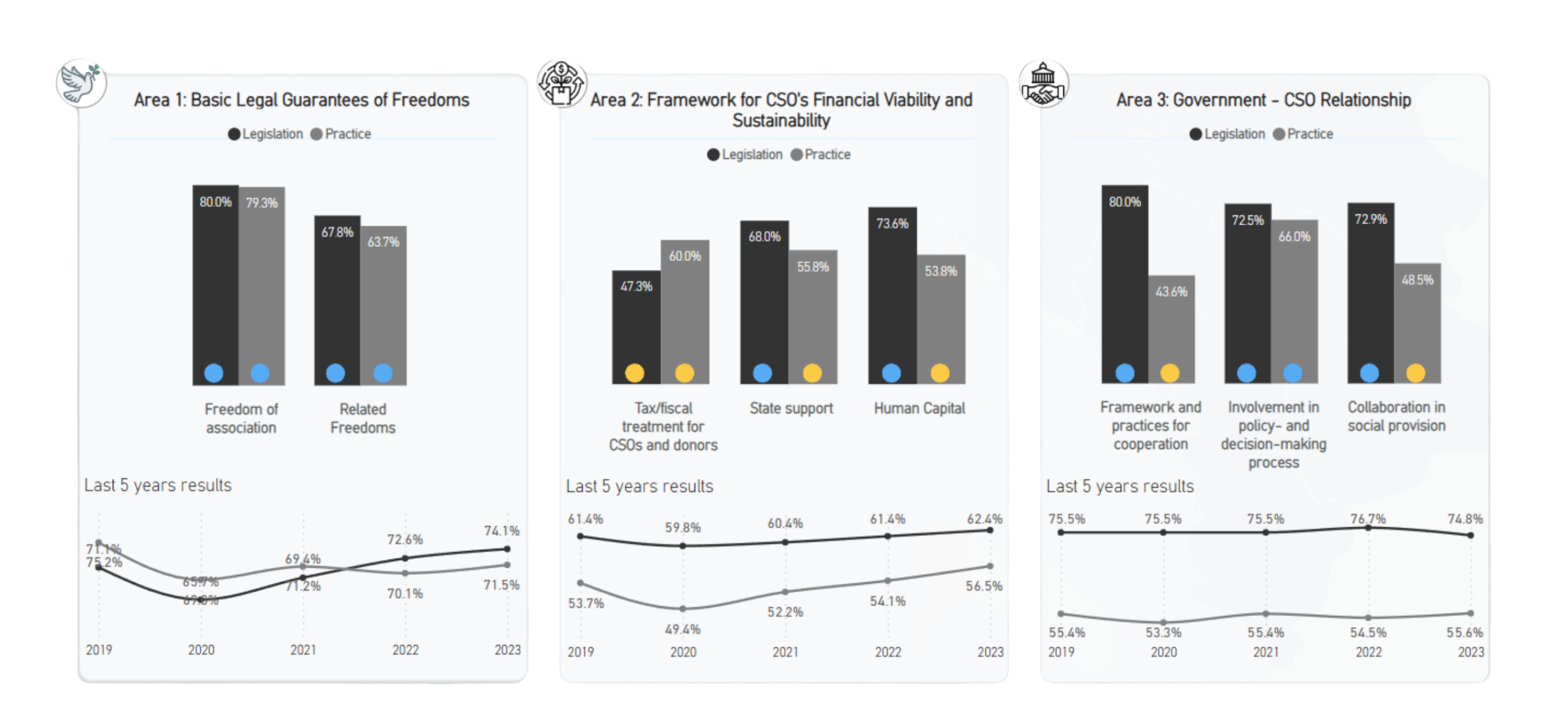
The state of the enabling environment in BiH is partially supportive for CSOs. The legal and regulatory environment provides certain freedoms, such as the ability to register and operate without excessive interference, and the capacity to receive foreign funding without major restrictions. However, challenges remain, including the complications regarding peaceful assembling, somewhat increased government interference, and freedom of expression related repercussions (such as the defamation law. Furthermore, the regulations differ in different parts of the country. Related to this, CSOs face hardship in terms of unclear taxation rules and restrictions stalling their financial sustainability. Inspections and fines indicate a level of scrutiny that some organizations find excessive. The key challenges for the future involve addressing differences between the three main laws for CSOs, regulatory inconsistencies and enhancing the autonomy of CSOs to engage in economic activities without fear of unreasonable penalties. Additionally, improving the legal framework to ensure clearer guidelines for the operation of CSOs and reducing bureaucratic hurdles will be crucial for fostering a more supportive environment and enhancing the civil society sector’s work.
The framework supporting the financial viability and sustainability of CSOs is diverse but complex, and it is assessed as more of a disabling than partially enabling environment. The state provides funding through intricate mechanisms at different government levels, with recent initiatives like the Draft Law on Financing NGOs FBiH and a forthcoming Strategy for the Development of the Non-Governmental Sector aiming to enhance support. However, funding processes often lack transparency, and access to both financial and non-financial resources remain challenging for CSOs. While human resource regulations ensure that CSOs are treated equitably with other employers, practical issues such as limited credit access and inadequate employment incentives persist. Volunteering is legally regulated but hindered by administrative burdens and infrequent incentives. Civic education is integrated into the curriculum, but actual youth participation in decision-making is limited. Overall, while frameworks and policies exist to support CSOs, there is a pressing need for greater transparency, improved support mechanisms, and more robust civic engagement to strengthen the sector’s sustainability and impact.
The state of the government-CSO relationship is between disabling and partially enabling environment, and it depends on the area of cooperation. At the state level, cooperation with the civil sector has been formalized through the Agreements on Cooperation from 2007 and 2017. These agreements have facilitated the development of cooperation, including interactions with civil society. The Advisory Body of the Council of Ministers of BiH for cooperation with NGOs, while partially functional, has worked on implementing planned activities but without public consultation with CSOs during 2023. The Advisory Body has been appointed in the working group for the Strategy for the Development of an Enabling Environment for Civil Society 2024-2028 in BiH. The involvement of organizations in the preparation, development, and adoption of strategic documents and laws remains sporadic and insufficient. Although a functional mechanism exists at the state level, such mechanisms are absent at other levels. The rulebook for public participation was revised in 2023, leading to some improvements, such as clearer responsibilities for consultation leaders and a reinforced obligation to publish consultation reports. Changes also include the possibility of adopting documents without a consultation procedure, which could present new challenges in the future. Amendments to the Law on Freedom of Access to Information have introduced obstacles for organizations, particularly affecting the appeals process and other provisions related to information availability. Cooperation in the provision of services has remained unchanged from previous years and has been evaluated as unprofessional, inconsistent, and lacking in administrative, qualitative, and financial aspects.
Key Positive Developments for 2023
- Bosnia and Herzegovina initiated the drafting of its first national Strategy for an
Enabling Environment for Civil Society Development. - The legal regulations regarding freedom of association and autonomy of CSOs are not harmonized at different levels, but they still comply with standards, ensuring an enabling environment.
- The law on anti-money laundering and financing terrorism was updated in 2023 i and adopted in 2024. Non-Profit Organizations, in terms of this updated Law, are deleted as obligers.
- The Council of Ministers initiated the development of the Strategy for the Development of an Enabling Environment for Civil Society 2024-2028. The Advisory Body of the CoM for cooperation with NGOs is named as a member of the working group. The strategy is expected to be adopted in 2024.
Key Negative Developments for 2023
- One of the strongest findings of this report is the violation of fundamental freedom of assembly by hooligans and the lack of institutional protection for activists. Cases of freedom of expression and assembly violations are recorded within Area 1.
- Although there is no clear and consistent framework for transparent public funding since the prescribed procedures exist at the state and RS levels, the weakest mechanism for distributing public funds to CSOs is in FBiH, including cantons. Still, CSOs in BiH see the public funding for CSOs as non-transparent process that is often abused for political purposes and is subjected to malversation.
- Organizations’ involvement in developing laws and strategic documents remains sporadic, with mechanisms only at the state level. The Rulebook for Public Consultation BiH has been revised with a few improvements and setbacks in the possibility of adopting documents without consultation. Changes to the Law on Freedom of Access to Information have made it harder for organizations, especially in the appeals process.


