
Executive Summary
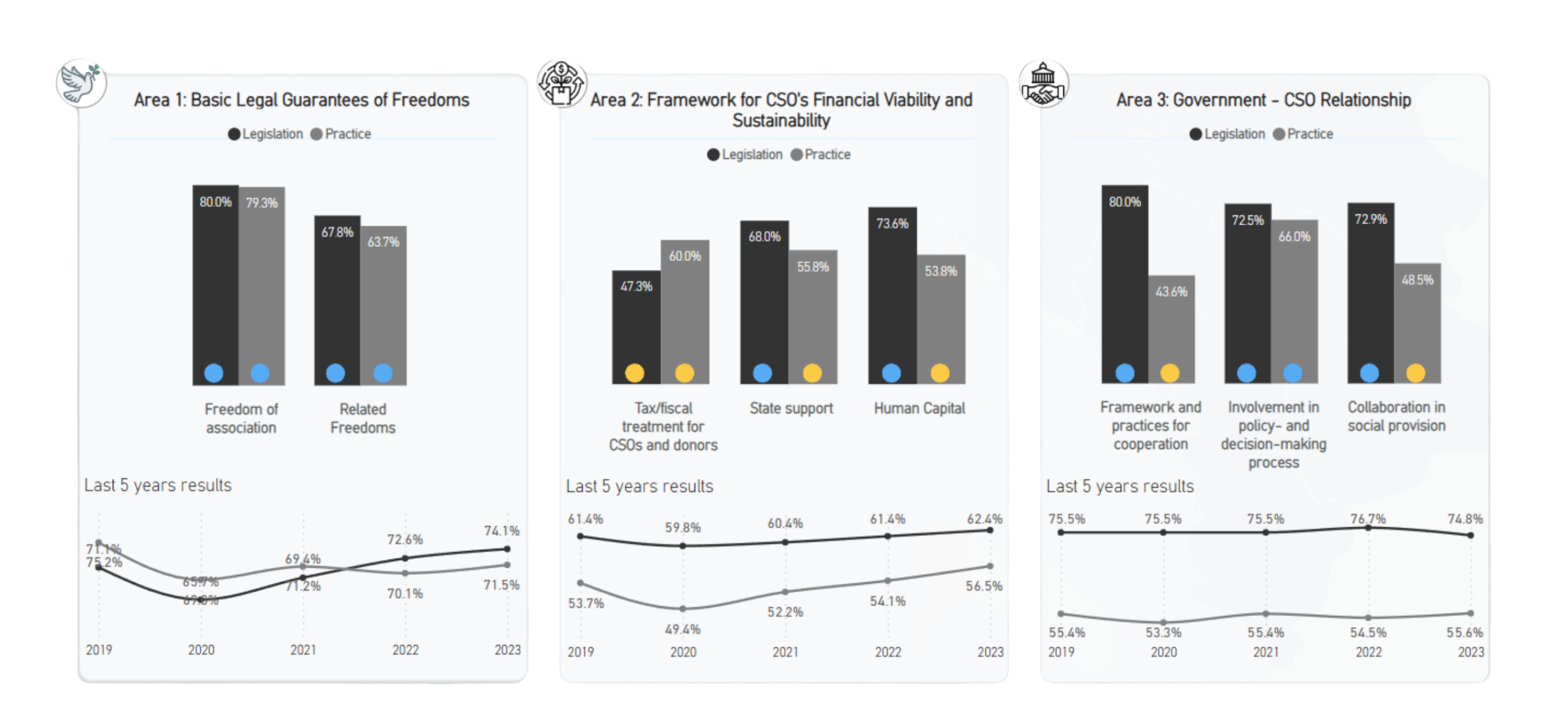
The report shows that CSOs face challenges that hinder their work. After multiple years of efforts, the working group for preparation of the new Law on NGOs has not delivered the draft yet, and the progress is unknown due to a lack of transparency in the process. The register of CSOs is functional and available online, with 7005 registered CSOs as of the end of 2023. However, the data available within is limited to a few main categories, lacking data such as: contact details, dominant area of work, funding received, number of employees and volunteers, etc. The data available is not in open format, lacking interoperability with other datasets which would enable easier analysis and monitoring of the main civil society development indicators.
Read more
Civil society enjoys considerable levels of freedom of expression, with sporadic and emerging threats coming, in some cases, from high government officials. Strategic lawsuits against public participation (SLAPPs) are present to a low extent, with multiple active cases. There is no systemic response to this threat, prompting CSOs and activists to rely on their own capacities.
Despite the legislation obliging ministries to conduct consultations in the beginning and final stages of policy making, this obligation is often neglected. Even though the Strategy for cooperation between State authorities and NGOs was adopted in 2022 for the period 2022-2026, the level of implementation of foreseen measures is low. Despite the opportunity for CSOs to participate in policy making and legislation drafting within working bodies, their interest in participation is low, to the extent that a part of working bodies was not able to form, such as the most important working body for cooperation: Council for cooperation between State administration and NGOs. The major cause for the lack of interest for working bodies comes from the interpretation of the Anti-corruption Law, equating CSO representatives in the working bodies with public officials, prompting reporting and administrative burdens.
There are minor tax incentives for CSOs, such as VAT exemption of EU funded projects, exemption from property and property sale tax, and tax incentives for donors. However, there is no concentrated effort on creating a favorable environment for philanthropy.
CSOs are funded majorly from abroad, primarily the EU. State funds are available, distributed by the line Ministries and Municipalities. The funds are planned a year in advance, but the calls for proposals are published late in the year, delaying the regular funding cycle. Complaints against the distribution of grants are abundant among civil society, accusing commissions and grantees of foul play. Besides the NGO funds distribution, CSOs also access other sources of funding to a smaller extent: direct transfers from the Government, tourism development grants, economic activity. Although some CSOs use state-owned premises, there are no clear criteria prescribed for awarding premises. Legislation on economic activity of CSOs remains limiting.
The legislation on service provision remains vague and undefined, with multiple pieces of legislation governing this area. Services provided by CSOs are most often financed through NGO grants, often bringing uncertainty to the continuation of funding.
Key Positive Developments for 2023
A new Youth Strategy in Montenegro emphasized volunteer programs in schools
and the eventual establishment of a public volunteer registry, advancing the culture
and practice of volunteering in the country.
Key Negative Developments for 2023
- There is not enough official data on the diversity of the civil society.
- Existing tax benefits do not encourage individual or corporate giving.
- The environment for CSO participation in policymaking is discouraging for CSOs.
- Service provision is not regulated by legislation.
- The implementation of the Strategy for cooperation between state authorities and NGOs is on a low level.
- The Council for cooperation between state authorities and NGOs is non-functional.
- Law on NGOs is in the drafting phase for over two years.
- The law does not provide early dismissal and protective mechanisms for SLAPP targets.


