
Executive Summary
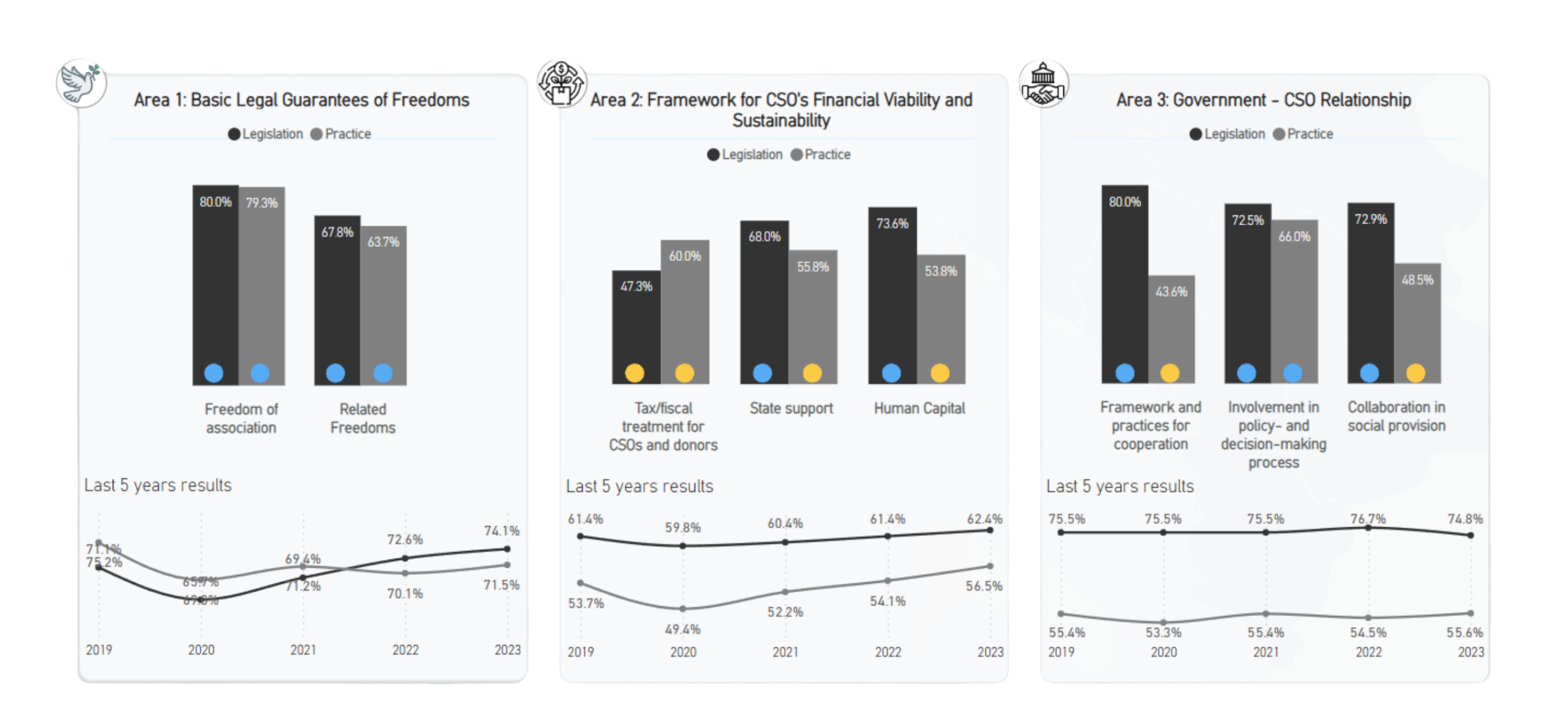
The “Monitoring Matrix on Enabling Environment for Civil Society Development – Türkiye Report 2022‑2023” provides an in-depth analysis of the conditions under which civil society organizations (CSOs) operate in Türkiye. Produced by TÜSEV and part of a regional initiative led by BCSDN, the report assesses the legal, financial, and political environment for CSOs based on international standards.
Read more
It finds that while Türkiye has a basic legal framework that allows for the existence of CSOs, the implementation of this framework is highly problematic. Laws governing freedom of association, assembly, and expression are restrictive and often applied in a way that limits civic space. Rights-based organizations and those addressing sensitive or minority issues face disproportionate challenges, including legal pressures and public smear campaigns, particularly in the polarized political atmosphere surrounding the 2023 elections.
Financial sustainability remains a major obstacle, as CSOs face limited public funding, burdensome regulatory frameworks, and a lack of long-term institutional support. The relationship between the government and civil society is characterized by a lack of meaningful dialogue, with public consultations often being symbolic rather than substantive. Despite their contributions to public service delivery, CSOs are frequently underfunded and excluded from policy processes.
The report calls for urgent reforms, including revising restrictive legislation, improving financial mechanisms, and establishing transparent, institutionalized forms of cooperation between the state and civil society. It also emphasizes the role of the EU and donors in supporting these reforms and strengthening civil society’s role in democratic governance. Overall, the report paints a picture of a shrinking civic space in Türkiye and underscores the need for comprehensive policy and legal changes to ensure an enabling environment for CSOs.
Key Positive Developments for 2023
- Improved public dialogue in Türkiye through series of meetings organized by state institutions to mitigate the unintended consequences of the AML and CFT measures, introduce methodology and criteria of ‘risk-based approach’, and get feedback from CSOs and bank representatives.
- From the first day of the earthquake, civil society organizations played an active role in various efforts, ranging from search and rescue operations to longterm reconstruction initiatives. During these activities, they at times encountered administrative and bureaucratic obstacles, such as the inability to obtain necessary permits or the suspension of their operations. Key challenges included difficulties in accessing affected cities and specific areas, accreditation requirements and permit procedures, variations in public sector approaches and practices across cities, post-earthquake bureaucratic procedures, as well as permits and protocols, uncertainties, ambiguities, and gray areas. Organizations develop various strategies to continue their activities in the face of these challenges, such as avoiding the use of their official names, leveraging informal networks, or pursuing legal action. At times, organizations also struggled to sustain their activities due to challenges not stemming from the public sector, such as difficulties in accessing financial resources
- Among the objectives of DGoF and DGRCS, the goal of enhancing public-CSO collaboration and strengthening civil society is defined. Some ministries also develop strategy documents and establish consultation or advisory bodies to enhance cooperation with CSOs working in their respective areas. However, none of these mechanisms fully meet the objectives of ensuring public-CSO collaboration, promoting civil society participation, addressing the problems of civil society in dialogue with CSOs, and fostering its development.
- Among the CSOs participating in the quantitative research, 27% stated that they had engaged in joint efforts with a public institution in 2022 or 2023. Among these CSOs, 44% participated in consultation and advisory meetings, 37% carried out joint activities, and 27% signed a collaboration protocol. Submitting written opinions during the legislative and policy development processes remains a rarely utilized form of collaboration and participation. Field research findings indicate that collaborations between the public sector and CSOs are generally ad hoc, while structured collaborations are rare and mostly established at the local level. Collaboration mechanisms within local governments are more recognizable and accessible to CSOs compared to mechanisms under central administration.
Key Negative Developments for 2023
- Although the legal framework for freedom of association is guaranteed by the
Constitution, existing legislation and practices impose restrictions that limit
the effective operation of CSOs. The inclusion of ambiguous concepts such as “public
morality” and “public order” in the legislation leads to interpretative differences,
increasing arbitrariness in enforcement and contributing to the shrinking of civic
space. - The bureaucratic and complex procedures involved in the establishment of
CSOs create an additional burden, particularly for small-scale and local associations.
Moreover, regulations on the minimum number of founding members and
the required number of individuals in governing bodies are not aligned with
international standards, making the exercise of freedom of association more difficult. - Many CSOs struggle with capacity building and long-term planning due to
the challenges and restrictions they face. A significant number of associations and
foundations stated that they were not affected by these challenges and restrictions.
These CSOs fall into this category not only due to their political stance but also
because of factors such as organizational size, financial resources, and established
traditions. However, even CSOs within this group acknowledge the need for changes
in areas such as tax regulations and legal infrastructure. - As the authorization process and the procedural and operational criteria for foreign
CSOs are not clearly defined, they face bureaucratic obstacles when establishing a
representative office or branch and conducting financial transactions in Türkiye. - Guidelines published and training sessions organized by relevant public
institutions on audits in recent years have had a positive impact. However, audit
processes still contain elements that restrict and pressure civil society organizations.
Rights-based organizations and CSOs working in specific areas or with particular
target groups face greater scrutiny and pressure during audits. - There have been instances where CSOs working in human rights or rights-based
areas have been targeted, publicly discredited, or subjected to smear campaigns. - The legal regulation of aid collection, the requirement for CSOs to obtain permits, and
the numerous conditions attached to these permits make it more difficult for CSOs
to ensure financial sustainability and access funding. With the enactment of Law No.
7262, the introduction of permit requirements for online aid collection activities and
international donations has made the legal framework even more restrictive. The Law
on Collection of Aid no longer meets current needs. - The procedures for CSOs to engage in economic activities are complex and
lack supportive mechanisms. Legal barriers to accessing foreign funding pose a threat
to the financial sustainability of CSOs. The tax exemptions granted to CSOs are
insufficient, and existing regulations further increase their financial burden. - Freedom of expression, guaranteed under Articles 25 and 26 of the Constitution, is
restricted through specific provisions of the Turkish Penal Code and the Anti-Terror
Law. In particular, Article 299 of the Turkish Penal Code on “insulting the President”,
Article 301 on “publicly denigrating the Turkish Nation, the State of the Republic of
Türkiye, or the organs and institutions of the State”, Articles 6 and 7 of the Anti-Terror
Law on “making propaganda for a terrorist organization”, and Law No. 7418, enacted
in 2022 and publicly known as the disinformation law, which amends the Press Law
and certain other laws, provide a basis for the suppression of critical opinions. This
situation limits the ability of both individuals and civil society organizations to express
critical opinions. - Law No. 2911 on Meetings and Demonstrations restricts fundamental
rights on ambiguous grounds, such as “national security” and “public order”. - Law No. 2911 on Meetings and Demonstrations, and its secondary
legislation impose restrictions on the location and duration of demonstrations
and marches. Although these activities are subject to a notification procedure, the
law introduces a bureaucratic notification system and grants broad discretionary
powers to administrative authorities and law enforcement. In practice, the
requirement of prior notification by law leads to considering spontaneous,
unplanned demonstrations as illegal, and prohibiting them. In numerous peaceful
demonstrations, instances of disproportionate use of force by law enforcement have
been observed. - Many individuals who seek to exercise their right to assembly and demonstration
face administrative fines under the Misdemeanors Law for allegedly participating in
or organizing gatherings/demonstrations deemed unlawful. Moreover, investigations
and legal proceedings can be initiated against individuals for violating Law No. 2911
on Meetings and Demonstrations. - New surveillance systems, such as CCTV cameras and facial recognition technologies,
pose a potential threat to fundamental rights, particularly freedom of expression. - CSOs remain vulnerable to digital threats while conducting their online activities. Data
privacy and cybersecurity risks negatively impact CSOs’ digitalization processes. - Tax incentives for CSOs are extremely limited, and there is no tax regime aimed at
strengthening their financial capacity. A limited number of tax incentives primarily
benefit a small group of CSOs that hold public benefit or tax-exempt status. CSOs
with these special statuses make up only 0.6% of the total active associations and
foundations. Among CSOs participating in the quantitative field research, 39% are
aware of tax incentives, and of those, 31% have benefited from at least one incentive
in the past two years. - All income-generating activities of CSOs are subject to taxation, and the economic
enterprises of associations and foundations are governed by the same tax regime as
commercial companies. Field research indicates that more than half of the economic
enterprises owned by CSOs operate at a loss, and due to tax obligations, low- and
medium-capacity CSOs are hesitant to establish such entities. - Although the requirements for obtaining public benefit and tax-exempt status vary
for associations and foundations, they remain restrictive. CSOs perceive
the application procedures for these statuses as overly complex and bureaucratic.
One of the primary concerns raised by applicants is the delayed response
times in the evaluation of applications. Through this decision-making process,
only a limited number of CSOs are granted public benefit association or taxexempt foundation status by Presidential Decree. This practice creates inequality
among CSOs. Research findings indicate that 68% of CSOs are unaware of these
statuses, 0.6% have applied and received them, 2.3% had their applications rejected,
and 29% are aware but have deliberately chosen not to apply. - There are no regulations promoting effective and strategic giving. The tax deduction
rate available to individual and corporate donors is very low, and the procedures
required to claim tax benefits are particularly unfavorable for individual donors.
Individuals who do not file an income tax return are ineligible for this tax deduction.
The tax regime, which allows tax deductions only for donations and contributions
made to CSOs with tax-exempt or public benefit status, results in only a few
organizations that work on specific areas benefiting from state support through tax
incentives. - There is no regular and continuous public funding mechanism that supports the
organizational infrastructure and activities of CSOs and is strategically planned for the
development of the sector. Due to a lack of coordination among ministries, there is no
unified approach or standardized practice in the planning, allocation, and monitoring
of funds. The processes are neither transparent nor clear, and norms do not include
accountability. The total public funding allocated to CSOs, and the amount provided to
them throughout the year cannot be determined. - Public funds fail to meet the diverse needs of civil society; while certain areas of
activity, projects, and CSOs receive greater support, others receive no support at all.
Among the CSOs participating in the quantitative research, 15% stated that they had
applied for grants and funding from central or local public administrations, while
only 10% reported having received support as a result of their applications. - The majority of CSOs are unable to employ full-time paid staff. Among the CSOs
participating in the field research, 63% do not have full-time paid employees. There
is no public incentive to encourage working in CSOs. Field research reveals that CSOs
without full-time staff struggle to sustain even their most fundamental activities, such
as economic operations, fundraising, and administrative tasks. - There is no regulation that serves as a legal framework for volunteering or volunteer
services. Comparable data aligned with international standards on employment and
volunteerism in CSOs is not collected. Public policies promote volunteerism limited to
areas such as disaster and emergency response and social aid. - There is currently no specific legal framework or binding policy document dedicated
to regulating public sector-CSO relations or contributing to the institutionalization
of these relationships, aimed at enhancing the development of civil society. The Civil
Society Strategy Document and Action Plan has not yet been enacted. - Another prominent finding is the increasing difficulty in entering into service-based
protocols with the public authorities compared to previous years. Among public
institutions, there is an increasing tendency to reject CSOs’ proposals for collaboration
in the provision of public services, on the grounds that the public sector already
provides these services, while also favoring partnerships with only certain groups of
CSOs. - In line with findings from previous years, many CSOs operating in various fields that
had previously been able to collaborate with public institutions have been unable to
establish similar partnerships in recent years. According to interviewees, the primary
reason for this shift is the current political climate, in which public authorities take
an increasingly restrictive approach toward civic space and view it as a potential
risk. The security-focused approach of public authorities toward civil society is
accompanied by a growing centralization trend in decision-making processes
within the public sector. Interviewees noted that since the mid-2010s, an additional
barrier to the establishment and diversification of public-CSO collaborations has
been the rise of a centralized bureaucratic structure. Under these conditions, it is
particularly emphasized that public officials at various levels hesitate to establish
partnerships with CSOs or take the initiative to foster collaboration. This situation
gives collaborations a non-institutional, personal, and informal character. - There is no public policy or strategy recognizing the importance of CSO participation
in the decision-making processes, defining or promoting participation processes.
The legal framework grants public authorities broad discretion in including CSOs in
these processes. The research reveals that in public-CSO collaboration and decisionmaking processes, it is CSOs—not public institutions—that take the initiative and bear
the responsibility for ensuring civil society participation. - There is a tendency to select CSOs for partnerships or consultation
processes based not on their expertise or competence, but rather on whether
they hold public benefit or tax-exempt status. Findings from various monitoring
reports and field research indicate that independent and rights-based CSOs
are excluded from these processes. There are no measures in place to ensure
favorable conditions for CSO representatives to freely express their views in advisory
boards. Due to the lack of official procedures and criteria regulating collaboration, the
participation of CSOs in consultation and engagement processes is not guaranteed
independently of their political orientations.


