
Executive Summary
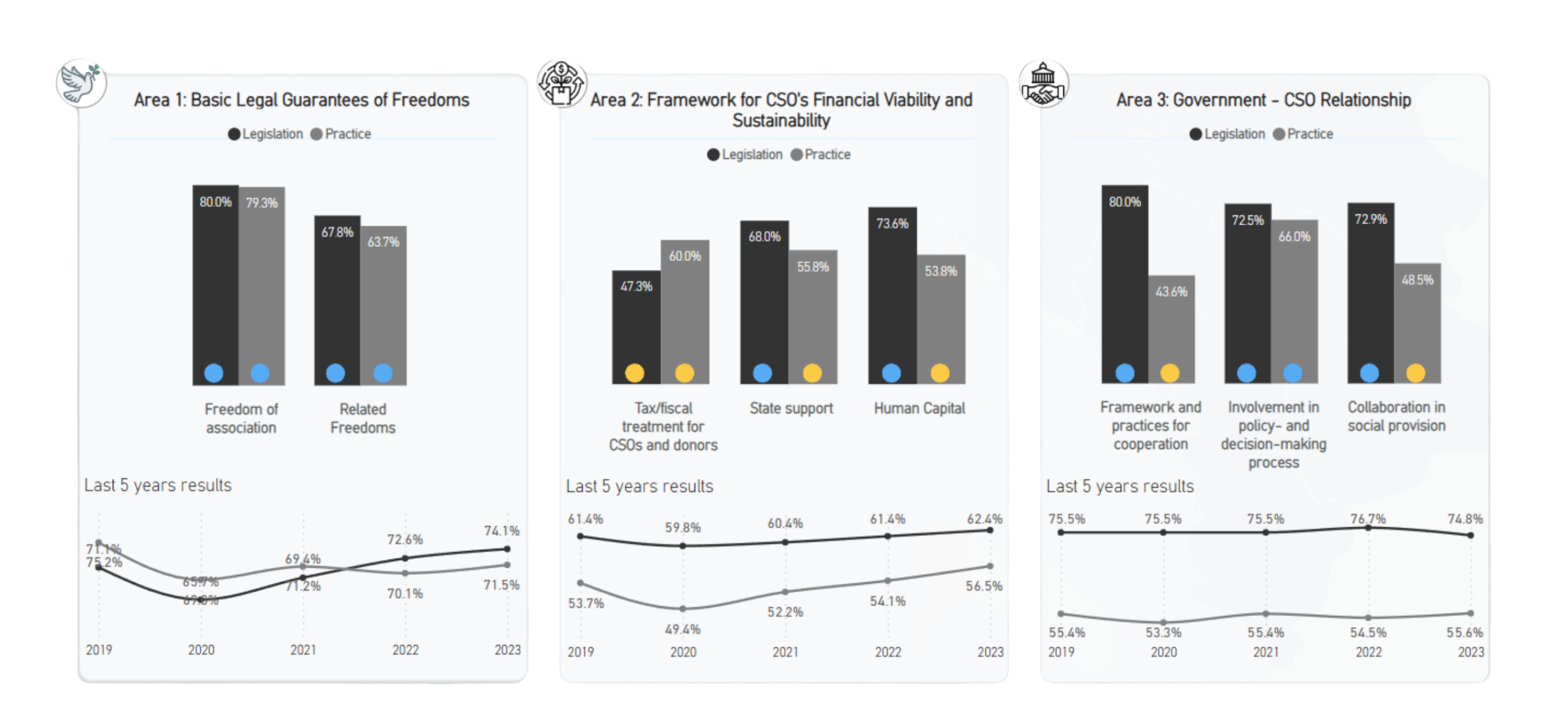
Key findings have not changed significantly compared to previous reports. Examining the legislation and practice, a trend of continued adverse conditions for the operation and development of civil society organizations has been observed. Fundamental freedoms and rights essential for a supportive environment for the development of civil society remain under attack. Those who led or supported these attacks have not been held accountable. Funding has continued for associations with well-founded suspicions of being established solely to apply for grants or being close to the authorities. The area of recognizing and encouraging the provision of services by institutions is not sufficiently developed, and civil society organizations continue to face difficulties in their operations.
Read more
The laws were adopted in a procedure characterized by non-transparency, arbitrary decision-making and changing of the adopted decisions. Freedom of expression is called into question by laws, by provisions that strengthen the dominance of state influence in the media. The new legal framework paved the way for a return to full state ownership of private media. The right to peaceful assembly has been called into question by the actions of the police, especially during the protests held after the elections in December. Civil society organizations continually operate under a persistent smear campaign and face an increasing threat from restrictive laws concerning the freedom of association, as well as the rhetoric employed by high-ranking officials to discredit and suppress public participation.
Key recommendations are directly aimed at addressing the main and priority challenges faced by civil society organizations in all three areas covered by this report. In the area of fundamental rights, we recommend enforcing regulations and holding accountable those responsible for attacks. We recommend developing incentives for giving, reforming the system of funding for public interest programs and projects. We recommend full implementation and monitoring of the documents related to creating an enabling environment for the development of civil society and recognizing and improving the position of civil society organizations in the field of service provision.
Key Positive Developments for 2023
The Government of Serbia established the Council for Creating an Enabling
Environment for the Development of Civil Society.
Key Negative Developments for 2023
- Violation of fundamental freedoms is one of the strongest findings of this report. Numerous recorded cases of violations of freedom of association, expression and assembly were recorded. Violations of human rights were particularly intensified during the pre-election and post-election period in December 2023. Targeting campaigns were a daily occurrence, directed against critical media, activists and civil society organizations, and orchestrated attacks start from the top of the state and later spread to pro-government media.
- During 2023, the problem of abuse of rights through SLAPP lawsuits, which target journalists, but also activists and the civil sector, are facing en masse, was highlighted.
- Different domestic and international reports assess a non-favorable framework for individual and corporate giving. There are no proper tax benefits underlying the further growth of giving. Implementation of existing incentives is not unique and different practices of the competent authorities in this regard are present. The definition of public interest is inconsistent in Law on Associations and tax laws. There is no system for collecting data on donations from citizens and businesses.
- Although there is a framework for transparent state funding, it still contains certain gaps, which allow for the prescribed procedures, and particularly the political influence on the final decisions. The state funding for CSOs in Serbia was one of the initial reasons for increasing GONGO activities and several such cases have been reported. In addition to GONGO organizations, phantom organizations are becoming more common, and through open calls, boasting connections with committee members, they receive huge sums of money. This threatens the survival of those organizations that actually work on important social issues. During the year 2023, examples of misuse of huge sums of public money were recorded through open calls by awarding them to phantom organizations.
- The legal framework still does not stimulate volunteering, does not acknowledge the value of volunteer engagement, and does not enable the collection and analysis of data on volunteers and volunteer hours.
- Although certain changes in the legal framework have been observed, they are not qualitative and do not address the problem of limited influence in the decision-making process. Due to the focus of the EU on quantitative criteria, a trend of faking public participation and debates was observed, with strong GONGOs activities.


