
Regional Reports
Executive Summary
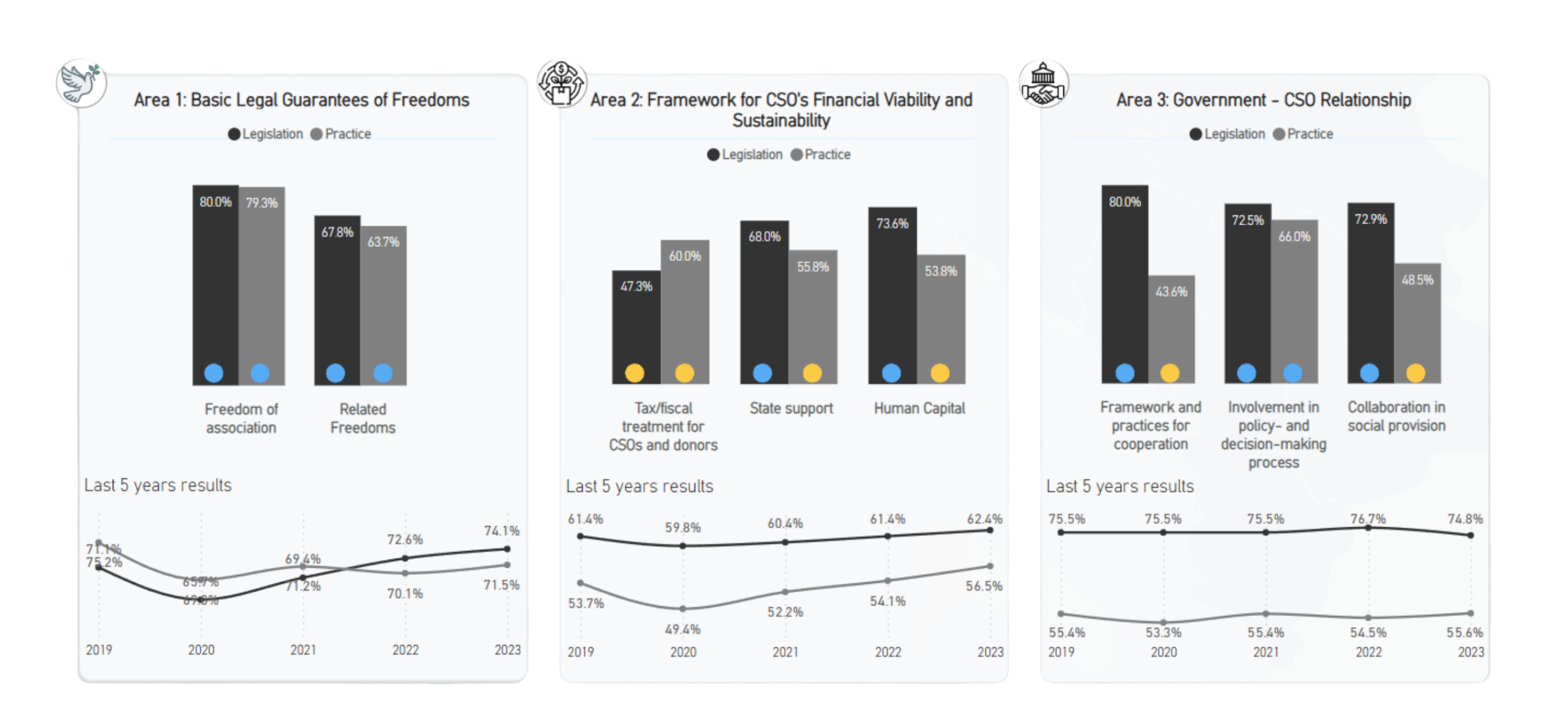
In 2024, civil society in the Western Balkans and Türkiye (WBT) continued to operate in a highly diverse and uneven environment, marked by notable disparities between legal guarantees and the reality of implementation. While most countries retained a generally enabling legal framework, persistent shortcomings in institutional practice, political will, and financial infrastructure undermined the sustainability and independence of civil society. Democratic backsliding, hostile narratives, and repressive legal initiatives gained ground in several countries, namely Bosnia & Herzegovina, Serbia and Türkiye, while isolated examples of policy engagement and support mechanisms illustrated the potential for progress when political will and civil society advocacy align. Across the region, legal guarantees for freedom of association are in place and generally in line with international standards, however the situation in practice is more complicated. Registration procedures are uneven and often burdensome—Albania lacks a functioning electronic system, while laws remain stalled in Montenegro and North Macedonia. AML/CFT obligations are still burdening in most countries, and used to put pressure on CSOs in some, but progress was noted in Kosovo and Montenegro. In Serbia, intensified political pressure has created a chilling effect. Though “foreign agent” laws were not adopted in 2024, narratives delegitimizing foreign-funded CSOs, especially in Türkiye, BiH and Serbia, continue to be used as tools of control.
Read more
This report provides a timely and evidence-based assessment of the state of civic freedoms and the
environment in which civil society across the Western Balkans and Türkiye operated during 2024, a period marked by intensified democratic backsliding and coordinated attempts to suppress dissent. While this report covers only 2024 developments, 2025 has already seen a further deterioration in several countries—particularly in Serbia and Bosnia and Herzegovina—underscoring that the threats are escalating and urgent to address. Drawing on over a hundred countrylevel data points, field research by national experts, verified incident reporting, and civil society consultations coordinated by the Balkan Civil Society Development Network, the analysis reflects both regional trends and country-specific developments. While the research prioritizes accuracy and triangulation of sources, some limitations persist, including incomplete data due to legal opacity and the underreporting of challenges faced by CSOs and activists working informally or in rural areas. This report maintains full editorial
independence. Its aim is not only to inform but to offer credible, actionable insights for policymakers, donors, and civic actors committed to reversing civic space erosion in the region.
Freedom of peaceful assembly is generally protected, though Türkiye continues to
impose sweeping restrictions and bans, and violations persist in Serbia and BiH. Peaceful
environmental and anti-corruption protests in Serbia were met with violence and mass
arrests. Freedom of expression is threatened by defamation laws (still criminalized in
Republika Srpska (BiH), Serbia, Albania, and Türkiye), SLAPPs, and shrinking media
independence. Serbia and Türkiye remain the most restrictive environments. Civic space
remains insecure. Activists, particularly from LGBTI+, gender, and environmental groups,
face surveillance, harassment, and smear campaigns. Spyware use in Serbia and protest
bans in Türkiye mark a deepening trend. Disinformation laws and bans (e.g., Albania’s
TikTok ban) undermine online rights. In North Macedonia, anti-gender movements are
gaining ground, using fearmongering to curtail civil rights discourse.
The financial sustainability of CSOs continued to be a pressing regional concern. While
the right to seek funding is legally protected, access remains difficult due to banking
restrictions, politicized oversight, and negative rhetoric. Tax frameworks for CSOs remain
underdeveloped and fragmented, with VAT exemption procedures still being a major
challenge for CSOs in Albania. Tax benefits are poorly implemented or limited to select
sectors. Public funding remains scarce, fragmented, and vulnerable to political influence.
Philanthropic engagement remains low due to legal ambiguity and lack of incentives.
Volunteerism remains poorly regulated, except in Türkiye where CSOs influenced draft
frameworks, and North Macedonia introduced civic engagement activities in schools.
CSO employment remains unstable due to limited access to benefits and state incentives,
such as social security, tax breaks, or maternity leave, while short-term funding and lack
of institutional support contribute to the broader structural instability of the sector.
Cooperation between governments and civil society remains inconsistent and generally
ineffective across the region. Despite formal inclusion, civic participation in policymaking
is weak. Consultations are often symbolic or rushed in most countries. Transparency and
access to information are limited, with regression noted in North Macedonia, Kosovo and
Albania, while rural CSOs remain excluded from digital engagement platforms.
Government-CSO cooperation Councils are inactive or underused in most countries,
except Kosovo. Serbia’s civil society increasingly withdrew from cooperation mechanisms
altogether, viewing participation as tokenistic and devoid of influence.
Overall, civic space continues to shrink amid regulatory inertia, political hostility, and
structural barriers. These trends are not isolated—they reflect a strategic attempt to
dismantle civic space and democratic pluralism. When protestors are beaten, journalists
sued into silence, and activists surveilled or harassed, the space for democratic debate
collapses. Inaction risks consolidating authoritarian tendencies and normalizing
repression. Policymakers must recognize that civil liberties are being eroded not by
dramatic legislation alone, but by bureaucratic suffocation, digital repression, and
unchecked political intimidation. To reverse the region’s downward trend and rebuild an
enabling environment for civil society, urgent action is needed to improve legal certainty,
institutional transparency, and sustainable financing, while safeguarding fundamental
freedoms as the cornerstone of democratic development
Key Positive Developments for 2024
The Financial Intelligence Agency in Albania, in collaboration with civil society, issued guidelines to help NPOs address terrorism financing risks – progress toward a risk-based AML approach welcomed by CSOs.
In BiH, Republika Srpska’s draft Law on Foreign-Funded CSOs, was withdrawn from parliamentary procedure in May 2024 following civil society and international backlash, marking a key pushback against restrictive legislation.
Kosovo’s new AML/CFT Law removed CSOs from the list of reporting entities—pending Constitutional Court review—marking a shift toward international standards and reduced administrative burdens.
Montenegro formally recognized CSOs as low-risk entities under AML/CFT regulations and clarified that executive directors—not founders—qualify as beneficial owners.
Mass civic mobilization in Serbia, including anti-corruption and environmental protests, highlighted growing public resistance to repression and deepening democratic backsliding.
CSOs in Türkiye actively participated in the development of a legal framework on volunteering, with most of their opinions and recommendations being addressed.
Key Negative Developments for 2024
In Kosovo, the government’s platform for tracking public funding to NGOs experienced a sharp decline in performance, as key institutions failed to upload data or submitted incomplete/duplicate entries, resulting in nearly €5 million in discrepancies.
State pressure on CSOs in Türkiye working in the fields of gender equality, LGBTI+ rights, ecology, migration, and human rights, especially those receiving foreign funding, increased in 2024, alongside a controversial draft law on “agents of influence” that threatened to criminalize critical voices and activism.
The failure to effectively regulate and implement VAT exemption on foreign funding continues to undermine the financial sustainability of Albania’s CSO sector, as the 2023 procedures remain too ambiguous to apply in practice.
In North Macedonia, the rapid adoption of laws without prior public notice or consultation sidelined civil society and undermined participatory policymaking. Despite formal consultation mechanisms, legislation was passed through hasty.
Montenegro saw intensified scrutiny of foreign-funded CSOs and proposals for foreign agent-style legislation. Although ultimately unsupported, these efforts—paired with declining transparency in public consultations and exclusion of CSOs from policymaking, signaled a troubling shift toward shrinking civic space.
Government officials and pro-government media in Republika Srpska (BiH) continued to label watchdog CSOs and independent media as “foreign mercenaries” or “enemies of the state,” exacerbating public mistrust and increasing risks for activists and journalists, while the re-criminalized defamation law created a chilling effect on public discourse.


