
Executive Summary
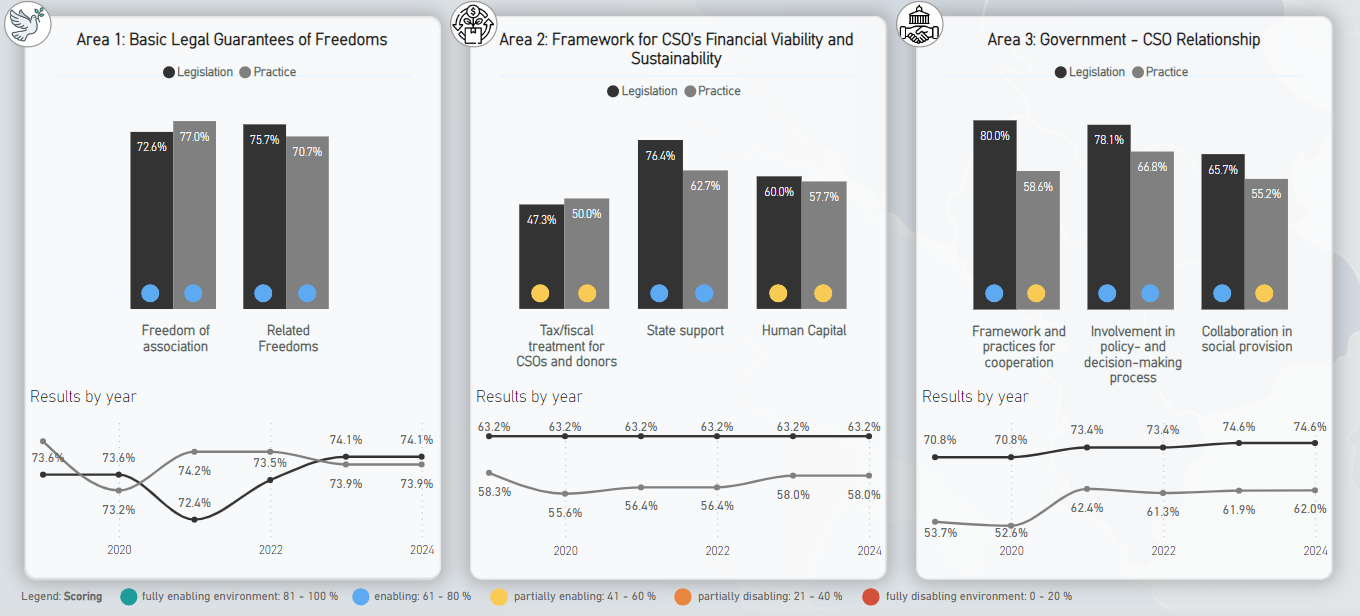
In 2024, Kosovo’s civil society experienced notable legislative developments, growing financial challenges, and limited involvement in key policymaking decisions. Overall, Kosovo’s civil society sector continues to demonstrate resilience and commitment despite growing financial uncertainty and legislative setbacks. The legal changes that took place during 2024 offer a structural foundation for stronger cooperation between institutions and civil society. Civil society advocacy also played a key role in preventing potentially harmful laws. However, these achievements remain vulnerable without continued funding, active participation, and robust safeguards. Addressing these gaps is crucial to maintaining democratic accountability, fostering civic engagement, and ensuring the sector’s long-term viability.
Read more
In 2024, the legal and policy framework for civil society in Kosovo remained largely enabling and aligned with international standards. The Law on Freedom of Association in Non-Governmental Organizations guarantees the right to freely establish and operate NGOs, and its implementation has generally been satisfactory. Civil society organizations, including those engaged in human rights and good governance, continued to operate without undue interference or delays from state authorities, reflecting a broadly open environment for freedom of association.
However, legal and regulatory developments introduced in 2024 to support the implementation of the Law on Freedom of Association raised concerns regarding their potential impact on the enabling environment. Two key instruments were adopted: Administrative Instruction on the Registration, Operation, and Deregistration of NGOs, and a Regulation establishing a Complaints Commission for NGOs. While the legal changes aimed to clarify existing legal obligations, such as the minimum capital requirement for establishing foundations and the enforcement of fines for delayed updates to the public registry, they also introduced a second-instance appeals mechanism, and a series of procedural changes, including an extension of the deadline for responding to NGO requests from 30 to 45 days. This new timeframe applies to various procedures, such as registration and the granting or revocation of public benefit status. The 45-day review period, particularly for registration, is notable given that registering any type of business in Kosovo typically takes only 2 to 7 days. Moreover, historically the Department for NGOs processed a low volume of registrations, averaging two per month, which had previously enabled faster turnaround times of one week to ten days.
The second-instance body for handling appeals against decisions by the Department of NGOs was formally established through Regulation (MIA) No. 01/2024 on the Complaints Commission for NGOs. The regulation was primarily intended to align NGO-related procedures with the Law on General Administrative Procedure, and to reduce unnecessary litigation. While this change promotes legal clarity and reduces reliance on the courts in resolving administrative disputes, the drafting process lacked meaningful participation by civil society. Although the Regulation was formally opened for consultation, the online platform malfunctioned, preventing institutions from accessing submitted comments, and CSO input was ultimately disregarded. The Complaints Commission’s composition remains dominated by government-appointed representatives.
A new Law on the Independent Media Commission (IMC) was adopted in March 2024, aiming to reform the regulatory framework for audiovisual media. Although the law was later annulled by the Constitutional Court in 2025, its adoption sparked significant public debate and criticism. While it did not directly address CSOs, the law was expected to expand to include media-focused CSOs. The proposed law faced strong criticism from journalists, and civil society, who raised concerns about the requirement that platforms publishing audio or video content register with the IMC, and the overall independent functioning of IMC. On April 23, 2025, Kosovo’s Constitutional Court annulled the new law following a legal challenge by opposition MPs, citing inconsistencies with constitutional principles. The full decision of the Court is still pending publication.
With regards to access to financial resources for NGOs, two legislative developments had mixed implications for CSOs. The Law on the Prevention of Money Laundering and Combating Terrorist Financing was amended by the government without prior public consultation in the online platform for public consultation. The positive development within the AML/CFT advocacy, is that the new-draft Law, approved in November 2024 by the Assembly, has removed NGOs as reporting entities. This change is expected to alleviates the heavy administrative burden and reduce the stigma associated with their classification as a high-risk sector. Furthermore, this initiative aligns with international best practices that recommend a more balanced, risk-based approach, maintaining financial security without hindering the key role of NGOs in civil society and in promoting democracy and transparency.
However, despite its approval by the Assembly, the new Law has not yet been enacted, as it has been brought to the Constitutional Court by opposition Members of Parliament. The Law is part of a broader package of legislation adopted during the Assembly session held on 13.11.2024, which the opposition has challenged the approval procedure. In parallel, the sectoral risk assessment for NGOs initiated several years ago saw significant progress during 2024 and is expected to be finalized soon.
Additionally, the adoption of Law No. 08/L-265 on the Register of Beneficial Owners aimed to establish a coordinated and accessible system for identifying individuals who control legal entities in Kosovo. This initiative sought to align national legislation with the Financial Action Task Force (FATF) standards and the EU’s 5th Anti-Money Laundering Directive (5AMLD), improving transparency and preventing money laundering and terrorism financing. However, the definition of beneficial ownership for NGOs is problematic, as it inaccurately equates founders with those who exercise effective control, ignoring the NGO governance structure defined by the Law on Freedom of Association. Additionally, the law also imposes disproportionate fines on NGOs by applying uniform monetary penalties that fail to distinguish between high-risk commercial actors and low-risk non-commercial organizations like NGOs.
The framework for CSO financial viability and sustainability remained the same in 2024 as in the previous years. Public funding continued to be made available at central and local levels through competitive processes. For the first time, the Ministry of Culture, Youth and Sports introduced a promising model of core, long-term support by launching a three-year funding scheme aimed at the organizational and programmatic development of NGOs in the field of art, culture and cultural heritage. According to the government’s online platform for reporting NGO funding, €8.68 million was allocated to NGOs in 2024 by both local and national levels. However, transparency and oversight of public funding further deteriorated. While functioning with partial reliability in previous years, the platform marked a sharp decline in performance in 2024. Multiple institutions failed to submit data, while others uploaded duplicate or incomplete records, resulting in nearly €5 million in discrepancies. No government body has taken responsibility for ensuring data integrity, and the Office of Good Governance has yet to implement an effective quality control mechanism.
In terms of state non-financial support to CSOs, the legal framework governing access to municipal property remained a key issue in 2024. Public property continues to be one of the few potential forms of tangible support available to CSOs in Kosovo, particularly at the local level; however, in practice, it has largely been allocated to businesses rather than civil society organizations. In December 2023, the Government approved a new draft Law on the Allocation for Use and Exchange of Municipal Immovable Property and submitted it to the Assembly. Although the draft passed its first reading in 2024, it contradicted the objectives outlined in the original Concept Document by restricting the use of municipal property to economic interests, thereby excluding purposes related to social or public benefit.
The draft law, as introduced, disregarded the public interest and risked institutionalizing practices that could enable the misuse of public property for political or commercial gain. In response, a coalition of NGOs coordinated by KCSF mobilized to advocate against the proposed legislation. Their efforts successfully led to the Speaker of the Assembly halting the process and initiating a parliamentary working group to revise the draft. During this process, KCSF drafted an alternative set of legal provisions addressing the most critical aspects of the law and succeeded in having many of these provisions included in parliamentary amendments. Unfortunately, the legislative term ended before the draft could be adopted, effectively resetting the process.
Although formally announced in January 2025, the abrupt suspension of U.S. foreign assistance exposed Kosovo civil society’s structural fragility and dependence on foreign donors. More than financial disruption, this development risks undoing a decades-long ecosystem of democratic development, participation and trust. KCSF’s survey revealed that a total of $28.22 million had been allocated through 68 active grants and contracts, some long-term and high-value, others short term and smaller in scope. The total expected funding lost between the end of January 2025 and the original contract end dates amounts to $11.61 million. The most affected programs are those serving youth, vulnerable groups, women’s rights, civic engagement and independent media.
The new Government Strategy for Cooperation with Civil Society 2025–2030 began drafting in 2024, following a gap year after the previous strategy ended in 2023. The process was coordinated by the Office for Good Governance and included consultations with civil society. The draft outlines four key objectives: promoting civic activism, securing sustainable and transparent funding, formalizing CSO involvement in public service delivery, and boosting volunteerism.
Contracting services from NGOs remained under regulatory review during 2024. The Ministry of Finance, Labor and Transfers initiated a drafting process in late 2023 to establish clearer procedures for contracting NGO services, initially in the form of a regulation, later reclassified as Administrative Instruction. The draft, developed with input from key public institutions and four CSO representatives, aims to improve procedural clarity, efficiency and financial sustainability. Consultations continued throughout 2024 and concluded in December, but the Administrative Instruction had not been formally adopted by mid-2025.
In 2024, public consultation remained largely procedural and continued to fall short of enabling meaningful CSO involvement. While nearly 80% of all drafted legislation and policy documents were made available for written or online consultation, the process remained largely performative in practice, falling short in terms of early engagement, diversity and engagement of participation methods and institutional responsiveness to public input. The Platform’s performance further declined in 2024, at times hindering institutions’ ability to review or respond to input. However, despite these challenges, CSOs and citizens remained the two most active contributors to the online consultation process during 2024.
Key Positive Developments for 2024
Removal of NGOs as reporting entities under the AML/CFT Law
The amended Law on the Prevention of Money Laundering, adopted by the Assembly in November 2024, removed NGOs from the list of reporting entities. This change, though still pending enactment due to a Constitutional Court challenge, aligns with international best practices and is expected to reduce administrative burdens and de-risk the sector.New long-term public funding model for cultural CSOs
For the first time, the Ministry of Culture, Youth and Sports introduced a three-year funding scheme for NGOs working in art, culture, and cultural heritage. This initiative represents a shift toward more predictable, core funding and organizational sustainability in a sector heavily reliant on project-based support.Effective civil society advocacy influenced legislative revision on municipal property
Civil society, coordinated by KCSF, successfully pushed back against a harmful draft law that would have excluded CSOs from accessing municipal property. Their advocacy led to the formation of a parliamentary working group and incorporation of CSO-proposed amendments, though the process stalled before adoption.
Key Negative Developments for 2024
Introduction of restrictive provisions through secondary legislation
New bylaws related to NGO registration and operation extended response deadlines (e.g., from 30 to 45 days) and introduced procedural hurdles, such as a more complex appeals process. These changes, although legally framed as clarifying, risk delaying and complicating basic NGO operations without clear justification.Severe decline in transparency of public funding data
The government’s platform for tracking public funding to NGOs experienced a sharp decline in performance. Key institutions failed to upload data or submitted incomplete/duplicate entries, resulting in nearly €5 million in discrepancies. No authority assumed responsibility for ensuring data accuracy or quality control.Suspension of U.S. foreign assistance exposed CSO financial vulnerability
Although announced in early 2025, the abrupt suspension of U.S. funding highlighted the sector’s fragility. More than $11 million in expected funding was lost across 68 grants, severely impacting programs for youth, women, vulnerable groups, and civic engagement—underscoring the urgent need to diversify and stabilize funding sources.


